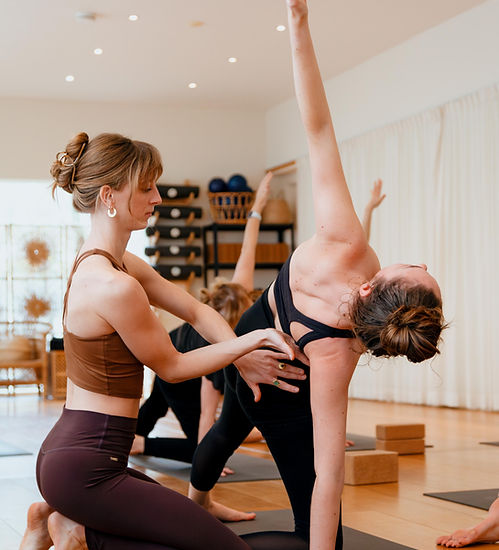
Most teachers either over-assist, fixing every body, or avoid touch altogether, unsure when or how. The difference isn't just more confidence; it's a clearer way of seeing. In this training, you learn to slow down, read what a body is actually doing, and respond with touch that supports rather than corrects.
YOU'LL LEAVE WITH
A clear framework for offering grounded, intentional hands-on assists
Greater confidence in reading bodies and movement patterns
Practical tools to support students through touch with clarity and respect
WHAT THEY ARE SAYING
Hear it from them
01
Embodied touch & presence
Explore touch as an extension of presence, not just a technique to apply. By working with your own body and perception first, you'll develop a clearer sense of grounding, timing, and quality of contact: touch that feels responsive and supportive, never directive or intrusive.
02

Reading bodies & movement patterns
Touch begins with seeing. Develop the skills to observe posture and habitual patterns in asana, and to recognise when and how touch may help, so assists respond to what's actually happening, rather than reinforcing compensations.
03
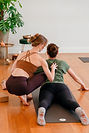
Hands-on skills you can trust
Learn a range of practical, safe techniques: grounding touch, directional support, and assists that invite organisation and ease rather than force or stretch. Equal attention goes to when to assist and which assist to choose, building real discernment and confidence.
04

05
06
THE PROGRAMME
Program overview
HANDS-ON TRAINING
A DAY AT THE TRAINING
Morning practice, built around the theme of the weekend
Theory and anatomy, explained and felt in your own body
Lunch break
Labs in pairs and small groups, with feedback
Integration, questions and reflection
WHY THIS TRAINING MATTERS
Hands-on assists are powerful, but they require clarity and sensitivity. Without a grounded framework, teachers either over-assist or avoid touch altogether, unsure when or how to intervene. This training offers a clear, embodied approach: the ability to observe, sense, and respond with confidence, so touch becomes a tool for connection, support, and learning rather than correction or hesitation.
YOU'LL BE ABLE TO
Observe posture and movement patterns with greater clarity and sensitivity
Offer hands-on assists that feel supportive, safe, and intentional
Use touch to support awareness, organisation, and ease in movement
Build trust and connection through respectful, presence-based assists
THE RETREAT
Getting there
Where you sleep
Food & Nourishment
A DAY AT THE RETREAT
Your trainers
Who you'll learn from
Fanny Alavoine and Willemieke Verweij teach this training together. Fanny brings functional anatomy and Rolfing® Structural Integration, so every assist starts from how the body is organised. Willemieke brings dance, somatics and presence, so touch becomes a conversation, not a correction.


It offered all the necessary tools to awaken that spark for hands-on assisting, making it feel both accessible and meaningful.
Szidónia
Really hands-on, with a lot of practice, which gave me the confidence to apply the new knowledge to my classes.
Kat
WHO IT'S FOR
Yoga, Pilates, barre and dance teachers
Passionate practitioners ready to deepen
No need to be an expert, just curious and committed
Teachers working toward their 300h
Teachers who want to give hands-on assists with confidence and consent
CERTIFICATE
Yoga Alliance Continuing Education
On completing the training you're eligible for a Yoga Alliance CE certificate, effective immediately. And if you go further, this module counts toward the full 300h Modern Vinyasa training.


PRACTICAL INFO
DATES
Fri–Sun, 20–22 November 2026
Fri 10:30–18:30 · Sat 11:30–19:30 · Sun 10:30–18:30
LOCATION
Tribes Studio 'The Flo', Floris Versterlaan 61, Leiden
15 min walk from Leiden Centraal. Restaurants and shops near the station, or bring your own: there is a fridge on site.
PRICE
€425
No VAT · CRKBO-registered · manual included
INCLUDED
3 training days (25 hours)
Training manual
Certificate of completion
Not included: travel and meals. There are plenty of places to eat near the studio, or bring your own: a fridge is available.
EARLY BIRD
€50 off with code ASSIST50 until 20 October 2026
PAYMENT
Paid in full when you book.
GROUP
Limited places
YOUR QUESTIONS
Good to know
Do I need a Vinyasa background for the weekend trainings and immersives?
No. Our weekend trainings and immersives are open to teachers of any style: yoga, Pilates, barre or dance. Being familiar with flow-style classes helps, but you don't need a Vinyasa background or a 200h Vinyasa training.
Are the manuals included?
No, the manuals are given to you as part of the training.
Do I need to be enrolled in the 300h Modern Vinyasa training to join this module?
No, you’re welcome to join this module as a standalone training. If you decide later to enrol in the full 300h programme, this module will count toward your certification.
How good does my English need to be?
Our trainee & trainer(s) community is international and multilingual: you’ll hear many accents and cultural backgrounds in the room. You do need a good understanding of English and the ability to communicate in it, but your English doesn’t have to be perfect. You’re always welcome to ask for clarification or repetition during the training.