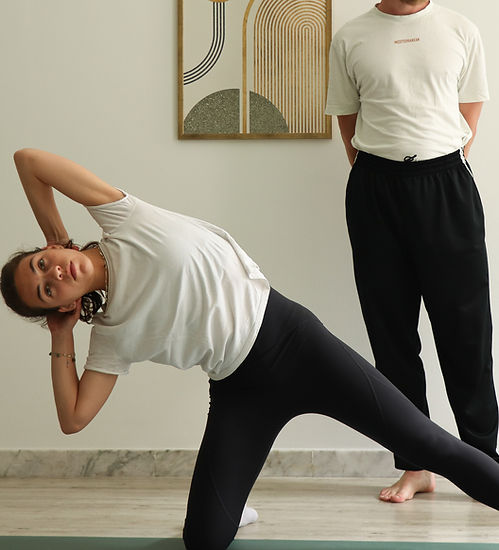
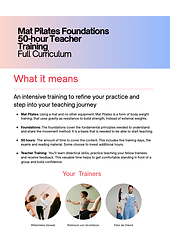
Six Sundays, three teachers, one goal: teaching Mat Pilates with confidence. You learn the essence of the method, the principles behind every exercise and how to help your students progress. Our approach is informed by the classical system, shaped by modern insights and built on thousands of hours of teaching.
YOU'LL LEAVE WITH
A complete foundational Mat Pilates class you can teach right away
A certificate of completion, after a practical and a theoretical exam
Reading and video material to keep coming back to
WHAT THEY ARE SAYING
Hear it from them
01
Technique
Master the technique of each exercise, for your own practice and so you can explain it clearly to others.
02
Didactics
How teachers, learners and knowledge interact: the base for clear cueing, a good class structure and useful feedback.
03
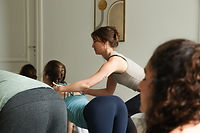
Anatomy
The anatomy you need to teach Pilates accurately, from the trunk and core to the shoulders, hips, knees, ankles and wrists.
04
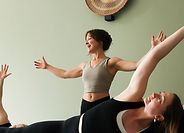
Biomechanics
Force, load, torque and movement chains: recognise the patterns in how the body coordinates movement.
05
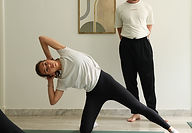
Observation
Train your eye to analyse, interpret and improve movement quality in the people you teach.
06
Sequencing
Learn a clear structure to build a well-balanced class, from opening and warm-up to a peak and a calm completion.
THE PROGRAMME
Program overview
Five training days and one exam day, on Sundays in Leiden. Every day has teaching labs and covers anatomy, biomechanics, didactics, sequencing and technique. Between training days you study reading and video material at home: reserve about 2 hours a week.
Day 1
Sunday 14 March 2027 · 9:30–17:30
Intention and direction
Opening our training, we direct the focus inwards to our bodies, breath and intention. This day is to determine where you stand and where you want to go. We analyse the first part of our foundational sequence, which covers the opening and warm-up of the class: several postures, their relationship to the ground and the available directions, and the starting positions from which many movements originate.
Anatomy: body orientation through anatomical positions, planes of movement, directions of joint motion, and the anatomy of the breath.
Biomechanics: the concept of force, external forces that work on the body and internal forces responding.
Didactics: verbal cueing strategies and the three phases of an exercise.
Sequencing: opening a class by bringing focus to breath and posture; warming up the body and preparing it for more movement.
Technique: use of breath, neutral alignment, symmetrical and asymmetrical movements.
Day 2
Sunday 21 March 2027 · 9:30–17:30
Flow & rhythm
Covering the centre part of the foundational class sequence, we focus on building towards a peak and dive into more technically complex exercises. This is where we train endurance and cultivate a deeper connection to the core. You learn how to offer a physical challenge and practise leading with enthusiasm, using your voice and vocabulary so your students feel encouraged and confident.
Anatomy: the trunk, including the spine, pelvis and ribcage, and the core muscle system binding these together.
Biomechanics: load and torque, and how these concepts help us increase or decrease demand.
Didactics: volume, tone and pacing of our verbal cueing.
Sequencing: how to build a peak that gives a boost of energy.
Technique: using the breath for core stability and strength; aligning the pelvis and ribcage for the anterior, posterior and lateral core.
Day 3
Sunday 4 April 2027 · 9:30–17:30
Expression
The final part of the foundational sequence covers exercises that require proper core activation. After awakening and cultivating the core, we send that power into the rest of the body and put new skills to the test with full-body expressions. We learn to sustain a relaxed awareness to bring a class to a proper close, and find out how to decompress and release excess tension.
Applied anatomy: the structure of the shoulder girdle and its organisation in Pilates practice.
Biomechanics: tension through pulling and stretching forces.
Didactics: expressing a unique teaching voice and signature.
Sequencing: bringing a class to completion, gradually reducing intensity and covering the remaining directions of motion.
Technique lab: differentiation and isolation as movement skills.
Day 4
Sunday 18 April 2027 · 9:30–17:30
Connection
Time to connect the dots. We explore how different parts of the body are linked and influence each other, and see the body not as a collection of separate parts but as an interconnected system. We glue exercises together into a unified whole, discovering how one exercise can lead into or build upon the next, until an intentional sequence comes to life.
Anatomy: the hip joint and its connection to the knee.
Biomechanics: movement chains, how the effect of a movement travels through the body, and how these chains connect to muscle slings.
Didactics: structuring a class with building blocks and keeping an overview.
Technique: smooth transitions between exercises.
Sequencing: the five phases of a sequence and lesson planning.
Day 5
Sunday 25 April 2027 · 9:30–17:30
Observation
This day is about the art of observation. Staying alert and responsive as a teacher enhances the focus in the whole room. Developing an embodied teaching presence, we explore how to position ourselves and move around the space while teaching, and how your place affects your ability to observe, communicate and guide the group.
Anatomy: the ankle and wrist joints, their relation to foot and hand placement, and how their position influences other joints.
Biomechanics: dynamic and static posture; evaluating postural alignment and movement quality.
Didactics: responsive cueing with clarity and effectiveness; tactile instruction and kinaesthetic learning through touch.
Sequencing: consciously positioning ourselves in the teaching room and developing spatial awareness as the observer.
Teaching lab: training your movement eye, looking at students and interpreting what you see.
Day 6
Sunday 2 May 2027 · 9:30–17:30
Evaluation · exam & graduation
The final day is a measure of your progress: time to translate your new skills and knowledge into action. See it as an opportunity to challenge yourself and discover what you are capable of.
Practical exam: you teach a 20-minute class to 3–4 fellow students.
Theoretical exam: 3–4 open questions, answered at home in your own time.
Graduation: everyone has set their own goals and intentions. We reflect on the journey, evaluate and celebrate together.
HANDS-ON TRAINING
Every training day has teaching labs: you teach your fellow trainees one on one and in groups of three, and get feedback from them and from the trainers.
A DAY AT THE TRAINING
Group practice
Technical and mechanical details of the morning's sequence
Didactics in small groups: explaining the exercises to each other
Lunch break
More movement & applied anatomy
Late afternoon: didactic theory and practice
WHY THIS TRAINING MATTERS
Finding good education among the many teacher trainings is a challenge. We found Pilates trainings that taught us the technique, but not the why behind it, and we were left with more questions and more curiosity. That curiosity brought us together as friends and colleagues.
This training is for those who like to ask why. Instead of looking at Pilates through the lens of right or wrong, we approach it with intention: each exercise has a purpose, so the key question becomes why you would do it. That opens the door to a more inclusive Pilates room, where people show up for their own reasons and practise at their own pace.
YOU'LL BE ABLE TO
Build a well-balanced class in five phases, from opening to completion
Cue clearly, with voice, pacing and hands-on guidance
Observe movement and adapt exercises to the people in front of you
Explain the why behind each exercise, through anatomy and biomechanics
THE RETREAT
Getting there
Where you sleep
Food & Nourishment
A DAY AT THE RETREAT
Your trainers
Who you'll learn from
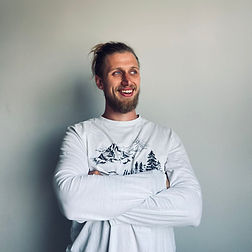
Three teachers, three angles. Robinson teaches the didactics: how to structure a class, cue with clarity and keep an overview of the room. Felix teaches the technique: how each exercise is built, and how to progress or regress it. Willemieke teaches anatomy, breath and movement: why the exercises work, so you can explain them and adapt them to the body in front of you.

I learned how to be a better teacher, in ways that can reach far beyond just Pilates. Best of all, I felt supported and got to grow with a fun group of interesting humans.
Lily
Now I'm teaching Pilates and helping others become healthier. Thank you for supporting and helping me turn my dream into reality!
Daria
I left the training with much more confidence, a whole new set of tools for my classes, and definitely a stronger core after our practices.
Maria
What I appreciated most was how Willemieke and Robinson emphasized that every body is unique, shifting the focus from how a posture looks to how it actually feels.
Lisa Bartels
WHO IT'S FOR
At least 3 months of Pilates experience
Attended at least 10 Pilates classes
No need to be an advanced practitioner or to perform exercises perfectly
Enthusiasm and curiosity are essential
Movement professionals, classical Pilates teachers and fitness instructors who want a modern, science-based approach
CERTIFICATE
Certificate of completion
You receive your certificate when you've attended all 6 days and passed both exams: a 20-minute class taught to 3–4 fellow students, and 3–4 open questions answered at home.

PRACTICAL INFO
DATES
6 Sundays: 14 & 21 March, 4, 18 & 25 April, 2 May 2027
Sundays 9:30–17:30, with a one-hour lunch break · about 2 hours of home study a week
LOCATION
Tribes Studios, Leiden: Doezastraat 2A or Floris Versterlaan 61
A 15-minute walk from Leiden Central Station. Free parking at The Flo (Floris Versterlaan).
PRICE
€1,050
Incl. 21% VAT
INCLUDED
5 live training days and an exam day
Daily teaching labs with feedback
Reading and video material for home study
Certificate of completion
Not included: travel and meals. There are plenty of places to eat near the studio, or bring your own: a fridge is available.
EARLY BIRD
€975 with code PilatesBird until 15 January 2027
PAYMENT
€250 non-refundable deposit on registration; the rest is due before the training starts.
Prefer to pay in instalments? On request: €1,100 in total, the deposit plus 3 instalments of €283.33. The first is due before the training starts, the second and third in the 2 months after. This option isn't available at checkout, so please email academy@yourtribes.nl before you book.
GROUP
Limited places
YOUR QUESTIONS
Good to know
Are there requirements to join the Pilates Mat Foundation?
You need at least 3 months of Pilates experience and to have attended at least 10 Pilates classes. You don't need to be an advanced practitioner or perform the exercises perfectly: enthusiasm and curiosity matter most. You're warmly invited to join our Pilates classes at Tribes to get familiar with our approach.
What is Modern Pilates?
Classical Pilates follows a set sequence of exercises in a particular order. Modern Pilates makes the method more accessible and updates it with recent scientific insights. Exercises are taught in progressions: you start with a lower-level version and gradually build up the demand.
What are the foundations of Pilates?
The why, what and how of the method: the focus, function and intention of each exercise. You leave with the essentials to start teaching and to help your students progress.
How do I prepare for the Pilates training days?
A training day is full of movement, in the brain and in the body, so make sure you're well rested! Between training days you receive reading material and videos to study at home. Reserve about 2 hours a week for this.
Will I be able to teach Pilates afterwards?
Yes! We encourage you to start teaching once you’ve completed your training. There’s plenty of opportunity to practise teaching with your fellow trainees during the training, with feedback from them and from the trainers. For extra practice, try teaching a friend or family member between training days.
I'm not sure I want to teach. Is this training for me?
Yes. Besides teaching skills, you gain a lot for your own practice: exercise technique, movement skills, an eye for efficient movement, progressive training and sequencing. Teaching labs are part of every day though: explaining an exercise to someone else is the best way to understand it.
Is there an exam in the Pilates Mat Foundation?
Yes. On the last day you teach a 20-minute class to 3–4 fellow students (the practical exam), and you answer 3–4 open questions at home, in your own time (the theory exam). Passing both gives you your certificate of completion.
How good does my English need to be?
Our trainee & trainer(s) community is international and multilingual: you’ll hear many accents and cultural backgrounds in the room. You do need a good understanding of English and the ability to communicate in it, but your English doesn’t have to be perfect. You’re always welcome to ask for clarification or repetition during the training.